The Boston Massacre did not occur in isolation, but was the culmination of a series of political, economic, and social tensions that had been building in the American colonies for over a decade. To understand how various street confrontations in Boston escalated into a deadly conflict, it is necessary to examine the broader context of imperial policy, colonial resistance, and the increasingly strained relationship between Britain and its North American subjects.
The roots of the conflict can be traced back to the aftermath of the French and Indian War (1754–1763). Britain emerged victorious from the war, but at a significant financial cost. In an effort to manage its war debt and maintain a standing army in North America, the British government sought to raise revenue from the colonies. This marked a departure from earlier practices, where colonial assemblies had largely controlled local taxation.
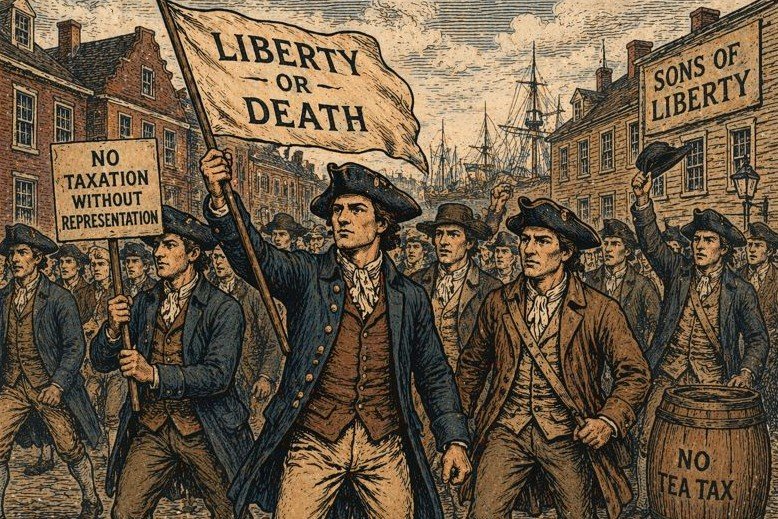
One of the first major attempts to implement this new approach was the Stamp Act. Although the tax itself was not especially burdensome, it represented a fundamental shift in authority. Colonists objected not only to the financial cost but to the principle of being taxed by a Parliament in which they had no direct representation. The widespread protests and boycotts that followed demonstrated both the depth of colonial opposition and the effectiveness of organized resistance. Whilst the Act was eventually repealed, it left behind a legacy of mistrust and a more politically engaged population.
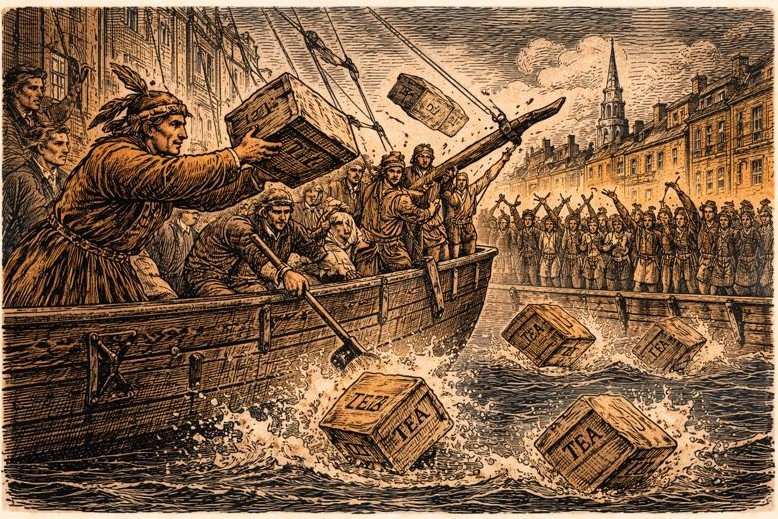
Tensions resurfaced with the introduction of the Townshend Acts, which placed duties on imported goods such as glass, paper, and tea. British officials believed these external taxes would be more acceptable than the internal tax imposed by the Stamp Act, but colonists largely rejected this distinction. Once again, the issue was framed in terms of “taxation without representation,” and resistance took the form of boycotts, protests, and political organizing.
Boston became the epicenter of this unrest. As a major port city with a strong tradition of political activism, it was particularly sensitive to changes in trade regulations and customs enforcement. The establishment of a Board of Customs Commissioners in the city brought British authority into direct and visible conflict with local interests. Smuggling, which had long been a feature of colonial commerce, became a focal point of enforcement efforts, further straining relations.
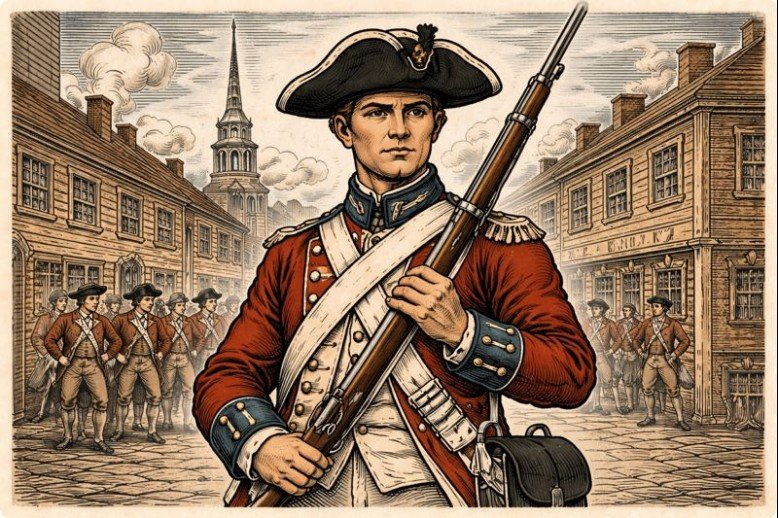
In response to growing disorder, Britain made a critical decision in 1768: it dispatched British Soldiers to Boston to maintain order and support customs officials. For British authorities, this was a practical measure aimed at ensuring compliance with the law. For many colonists, however, the presence of a standing army in a civilian setting was deeply alarming. It was seen not as protection, but as occupation; a means of enforcing unpopular policies through coercion rather than consent.
The daily interaction between soldiers and civilians intensified existing tensions. British troops, often young men from working-class backgrounds, were poorly paid and sometimes sought additional employment in the city. This brought them into direct competition with local laborers, who resented both the economic threat and the broader political implications of the soldiers’ presence. These grievances were not abstract; they played out in everyday encounters, where insults, arguments, and occasional fights became increasingly common.
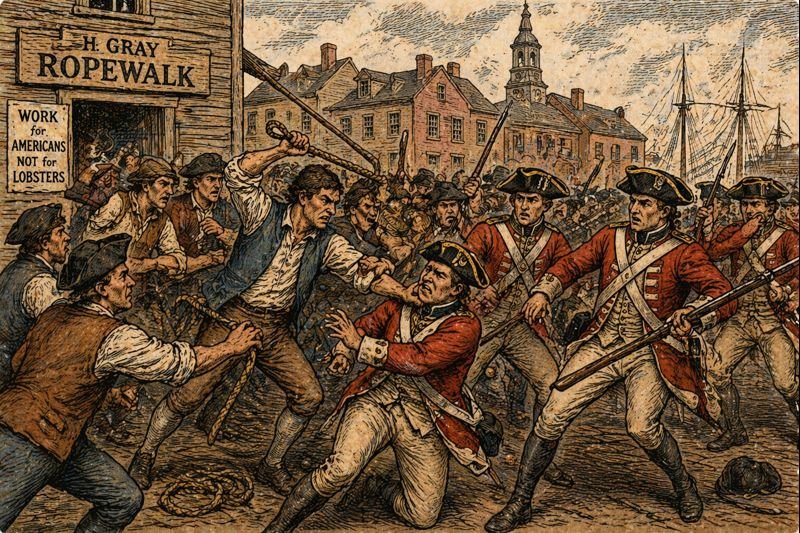
The situation reached a new level of volatility with the ropewalk fights in early 1770. These clashes, which took place between soldiers and workers at Boston’s rope-making facilities, were sparked by disputes over employment but quickly escalated into broader confrontations. Over several days, groups of soldiers and civilians engaged in repeated skirmishes, using fists, clubs, and improvised weapons. These incidents illustrated how economic competition, personal animosity, and political tension had become deeply intertwined.
By March 1770, Boston was a city on edge. The combination of political grievance, economic hardship, and military presence had created an environment in which even minor incidents could escalate rapidly. On the evening of March 5th, a confrontation between a British sentry and a group of colonists drew an increasingly large and hostile crowd. Insults were exchanged, and objects such as snowballs and debris were thrown. As tensions mounted, additional soldiers were called to the scene.
What followed was a chaotic and confused incident/event. Amid the noise, pressure, and fear, shots were fired into the crowd, resulting in the deaths of five colonists. Whilst the exact sequence of events remains debated, there is little doubt that the events leading up to the confrontation played a decisive role. The soldiers were operating in an environment of sustained hostility, whilst the crowd was reacting to what it perceived as an oppressive military presence.
In this sense, the Boston Massacre can be understood as the product of accumulated tensions rather than a singular act of violence. The policies enacted by Britain, particularly in the wake of the French and Indian War, had altered the relationship between the colonies and the imperial government. Resistance to these policies had, in turn, fostered a culture of protest and defiance. The introduction of troops into this already volatile setting brought these forces into direct and often combustible contact.
The events of March 5th, 1770, were therefore not an abrupt incident, but the result of years of escalating conflict. They marked a point at which political disagreement, economic rivalry, and social tension converged in a dramatic and tragic way, setting the stage for the further incidents which would eventually lead to revolution.