The trial of the British soldiers following the Boston Massacre stands as one of the most revealing moments in the early American struggle, not simply because of the violence that preceded it, but because of how the colonists chose to respond in its aftermath. At a time when emotions were running high and anti-British sentiment was reaching a boiling point, Boston’s leaders made a deliberate and, in many ways, remarkable decision: the soldiers would receive a fair trial under the rule of law.
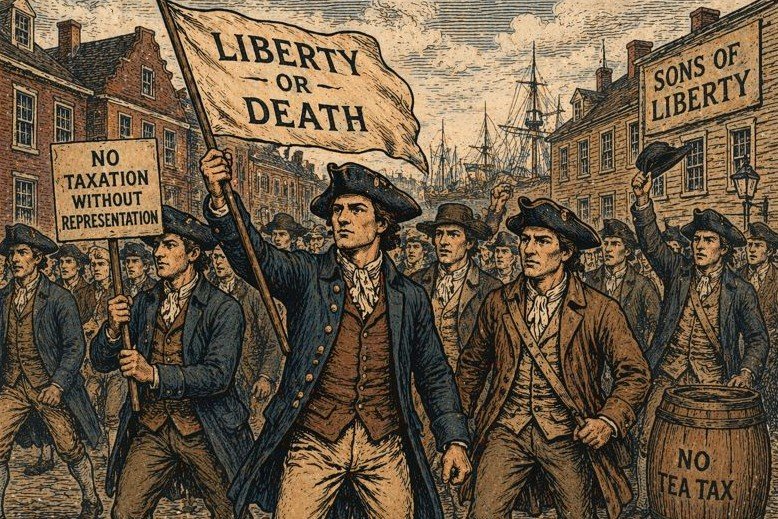
In the immediate aftermath of the shootings on March 5, 1770, public outrage was intense. Five colonists had been killed, including Crispus Attucks, and the incident was quickly framed by patriot leaders as evidence of British tyranny. Propaganda, most famously in the form of engravings by Paul Revere, portrayed the soldiers as disciplined executioners firing into an innocent crowd. In such a climate, the expectation might reasonably have been swift and severe retribution. Yet this was not what occurred.
Instead, the soldiers involved were arrested and charged, and arrangements were made for their defense. This decision was closely tied to the influence of patriot leaders such as Samuel Adams, who, despite being a central figure in resistance to British rule, understood the broader implications of how justice was administered. Adams and others recognized that the colonial cause was not simply about opposing British authority, but about asserting a moral and legal standard that distinguished the colonies from what they perceived as arbitrary rule.
Whilst Adams himself did not act as legal counsel, he played a critical role in ensuring that the soldiers would be tried fairly and that the proceedings would reflect the principles the patriots claimed to uphold. The actual defense was undertaken by John Adams, a cousin of Samuel Adams, who took on the unpopular and potentially dangerous task of representing the accused soldiers. John Adams later reflected that this was one of the most important actions of his career, precisely because it demonstrated a commitment to justice over passion.
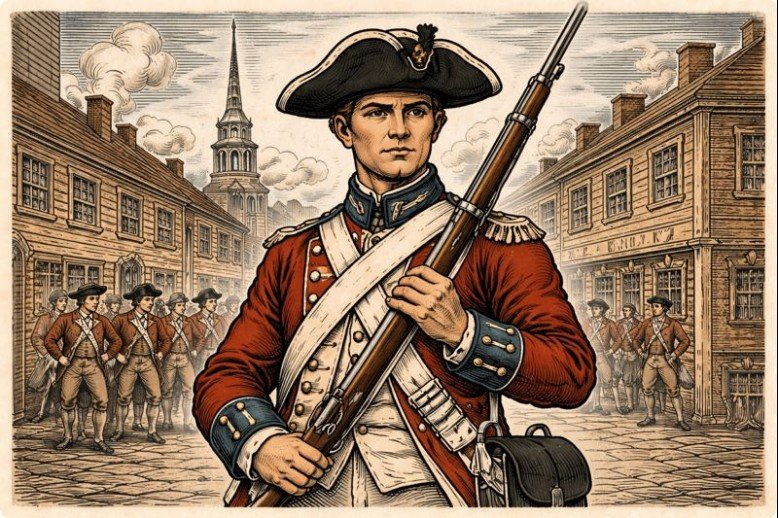
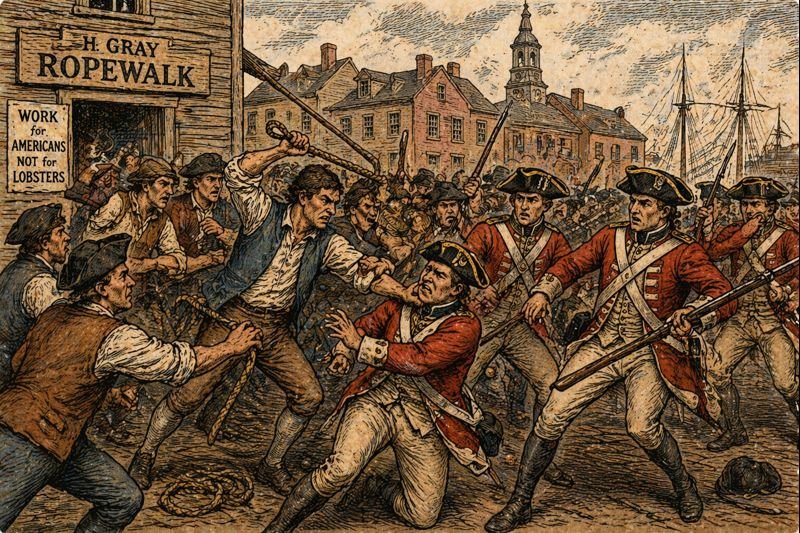
The trials, held later in 1770, were conducted with a level of care that underscored the seriousness of the moment. Evidence was presented, witnesses were examined, and the chaotic nature of the confrontation was explored in detail. Central to the defense was the argument that the soldiers had acted in self-defense. They had been confronted by an aggressive crowd, subjected to taunts, threats, and projectiles, including snowballs and pieces of ice that may have contained stones. In the confusion and fear of the moment, the defense argued, the soldiers believed their lives were in danger.
The jury ultimately acquitted six of the eight soldiers. Two were found guilty of manslaughter rather than murder, a distinction that acknowledged wrongdoing whilst recognizing the mitigating circumstances. These two soldiers received relatively lenient punishments, branding on the thumb rather than execution. For many in Boston, this outcome was difficult to accept, given the loss of life. Yet it was also widely understood, at least among the colony’s leadership, that the integrity of the legal process had been preserved.
Samuel Adams’s support for a fair trial was rooted in both principle and strategy. On one level, it reflected a genuine belief in the importance of justice and due process. If the colonies were to argue that British rule was unjust, they needed to demonstrate that they themselves adhered to higher standards. A mob-driven punishment of the soldiers would have undermined this claim, reinforcing British assertions that the colonies were lawless and incapable of self-governance.
On another level, Adams understood the power of perception. By ensuring that the soldiers received a fair trial, the patriot movement could present itself as rational, disciplined, and morally grounded. This was crucial not only for maintaining internal unity but also for gaining support from more moderate colonists and from observers in Britain itself. The trial became a way of illustrating that the colonial grievance was not with law and order, but with how that law was being imposed.
The proceedings also highlighted a key tension within the revolutionary movement: the balance between justice and political necessity. whilst public anger demanded accountability, the leadership recognized that true legitimacy came from restraint. In this sense, the trial of the British soldiers became an early expression of what would later be framed as American ideals, fair trials, the presumption of innocence, and the right to a defense, even for those widely despised.
In retrospect, the trial can be seen as a defining moment in the development of American legal culture. It demonstrated that even in times of crisis, there was a commitment, at least among the leadership, to uphold the rule of law. Figures like Samuel Adams understood that the revolution would not be won solely through protest and resistance, but through the ability to articulate and embody a vision of justice that set the colonies apart from the system they opposed.
The irony, of course, is that this commitment to justice was extended to soldiers who were themselves part of an occupying force. Yet this is precisely what gives the episode its enduring significance. By insisting on a fair trial for their adversaries, the colonists were not just defending the rights of a few individuals; they were defining the principles upon which their emerging society would be built.