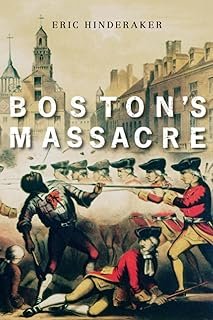
”Boston’s Massacre” by Eric Hinderaker offers a detailed and revisionist account of the Boston Massacre, moving beyond a simple retelling of events to explore how the incident has been understood, debated, and remembered over time. Rather than presenting the massacre as a clear-cut case of British brutality, Hinderaker examines the complexity and ambiguity surrounding the confrontation, emphasizing that what happened on March 5th, 1770, has always been contested.
A central theme of the book is that the Boston Massacre was not just a single event, but a layered historical process involving facts, interpretations, and evolving meanings. Hinderaker structures his analysis around three key elements: the event itself, the competing narratives that emerged immediately afterward, and the ways in which the massacre has been remembered and used in later periods. This approach allows him to show that the “truth” of the massacre is difficult to pin down, as eyewitness accounts were contradictory and shaped by personal and political biases.
Hinderaker places the event within a broader imperial and urban context, highlighting how tensions in Boston had been building for years. The presence of British troops, economic struggles, and conflicts over authority all contributed to a narrative where violence became increasingly likely. He argues that the massacre was not an isolated incident, but the product/result of structural changes within the British Empire, including the normalization of a standing army and attempts to exert tighter control over colonial cities.
Another important contribution of the book is its focus on narrative and propaganda. Hinderaker demonstrates how different groups such as patriot leaders, British officials, and later historians etc., constructed competing versions of the massacre to serve their own purposes. The famous depiction of the event as an unprovoked attack on innocent colonists is contrasted with accounts that emphasize the threatening behavior of the crowd. In this sense, the book shows that the Boston Massacre was as much about storytelling as it was about violence.
Hinderaker also traces how the meaning of the massacre has changed over time. In the 19th century, figures such as Crispus Attucks were reinterpreted in new political contexts, particularly in debates about race and abolition. In more recent history, the event has been invoked in discussions about state violence and protest, demonstrating its continued relevance.
Overall, Boston’s Massacre challenges readers to rethink a familiar historical episode. By focusing on uncertainty, interpretation, and memory, Hinderaker presents the massacre not as a fixed moment with a single meaning, but as an event whose significance has been shaped and reshaped over generations.