The Battle of Concord, fought on April 19th, 1775, was a continuing escalation in the opening phase of the American Revolutionary War. Whilst the earlier encounter at Battle of Lexington marked the first exchange of fire, it was at Concord that colonial resistance became organized, determined, and strategically effective. Together, these engagements transformed a political crisis into a sustained armed conflict.
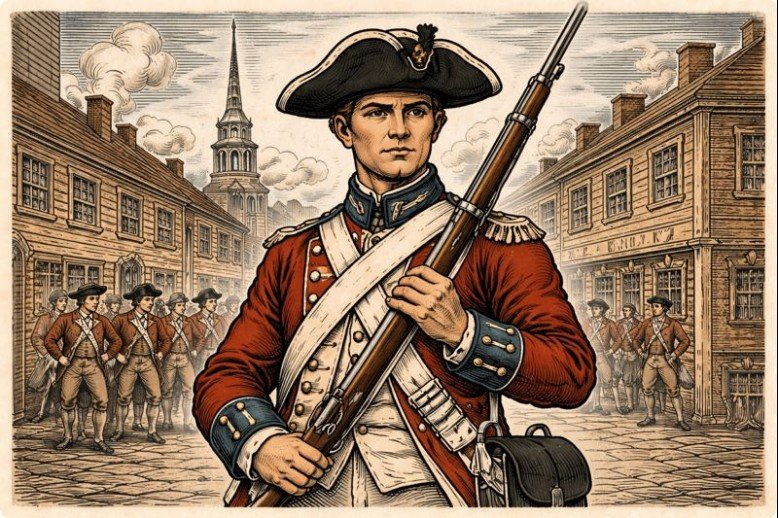
The British mission to Concord was part of a broader plan devised by General Thomas Gage, the military governor of Massachusetts. Intelligence had indicated that colonial militias were storing weapons, ammunition, and supplies in the town. Gage’s objective was to march a force of approximately 700 regular soldiers from Boston to Concord, seize or destroy these military stores, and, if possible, disrupt the growing organization of the colonial resistance. The expedition was intended to be swift and decisive, demonstrating British authority while avoiding a larger confrontation.
However, as with the march to Lexington, secrecy proved impossible. Colonial networks, including riders such as Paul Revere, ensured that word of the British advance spread rapidly through the countryside. By the time British troops reached Concord later that morning, local militias had already begun to assemble in significant numbers, drawn not only from Concord itself but from surrounding towns.
Upon arrival, British forces began searching for military supplies. Some stores were discovered and destroyed, but much had already been hidden or removed by the colonists. While British troops carried out their orders, militia forces gathered on the outskirts of the town, observing and preparing. Unlike the small and hesitant group at Lexington, these militias were larger, more organized, and increasingly willing to engage.
The turning point came at the North Bridge, a strategic crossing over the Concord River. A detachment of British soldiers had been posted there to secure the area while the main force searched the town. As smoke from burning supplies rose into the sky, colonial militia forces, numbering several hundred, advanced toward the bridge. Many believed that the British were setting fire to the town itself, heightening their sense of urgency and anger.
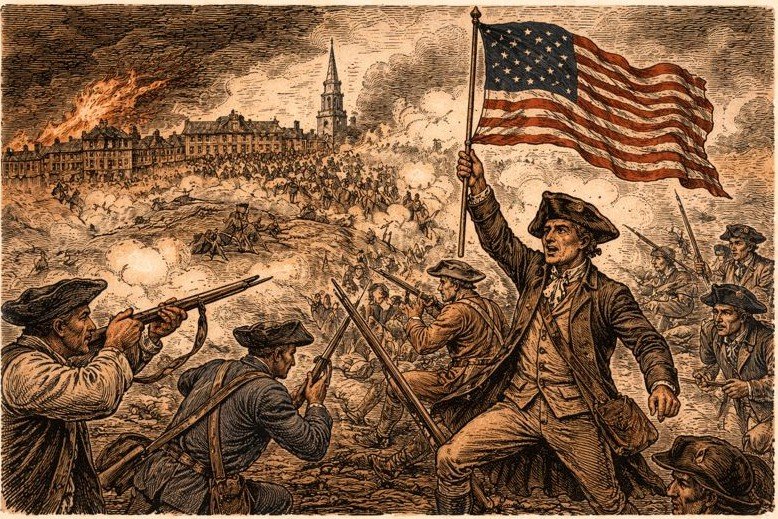
At the bridge, a tense standoff developed. The colonial forces, under the command of officers such as Major John Buttrick, formed ranks and began to advance. The British troops, facing a growing and determined force, fired a volley. Unlike at Lexington, where the militia had quickly dispersed, the colonists at Concord held their ground and returned fire. This exchange marked a critical shift: colonial forces were no longer merely reacting but actively resisting.
The British detachment at the North Bridge was forced to retreat, suffering casualties and ceding control of the crossing. This was a significant moment, as it demonstrated that colonial militias could stand against regular British troops in open confrontation. The psychological impact of this was profound, both for the colonists, who gained confidence, and for the British, who began to recognize the scale of the resistance they faced.
Following the engagement at the bridge, British forces began their march back to Boston. It was during this retreat that the battle evolved into something even more consequential. Militia units from across the region converged on the route, employing tactics that would later be associated with guerrilla warfare. Fighting from behind trees, stone walls, and buildings, they harassed the British column continuously, inflicting casualties and creating constant pressure.
This phase of the battle turned the British withdrawal into a prolonged and dangerous retreat. What had begun as a controlled military operation became a struggle for survival, as the regular troops were subjected to relentless attacks over miles of countryside. Reinforcements eventually arrived from Boston, preventing a complete collapse, but the experience revealed the vulnerability of British forces in a hostile environment.
The Battle of Concord, particularly the events at the North Bridge and the subsequent retreat, had far-reaching consequences. It demonstrated that colonial militias were capable not only of resisting but of coordinating their efforts across a wide area. The rapid mobilization of forces from multiple towns showed a level of organization and commitment that surprised British commanders.
Equally important was the symbolic impact. If Lexington represented the start of armed conflict, Concord represented its transformation into a sustained conflict. The phrase “the shot heard ’round the world,” often associated with these events, captures the broader significance of the day. News of the fighting spread quickly throughout the colonies, galvanizing support for the revolutionary cause and convincing many that reconciliation with Britain was becoming increasingly unlikely.
In the days and weeks that followed, militia forces surrounded Boston, effectively placing British troops under siege. The conflict that had erupted at Lexington and Concord would continue to escalate, leading to larger battles and the eventual formation of a Continental Army under George Washington.
In this way, the Battle of Concord was more than a single engagement; it was a turning point. It marked the moment when colonial resistance became both militarily viable and politically irreversible, setting the stage for a war that would reshape the course of history.